Tag: School Choice

AUSTIN: School Choice SB 276 Senate Education Cmte Hearing Thur., 3/26/15 Capitol, All Day

Jim and I will be at the hearing on Thurs. Mar. 26, all day. If you can get the day off, come out and support School Choice in Texas!

Support SB 276 for School Choice

Kingwood TEA Party and the Lt. Governor’s Grassroots Advisory Board strongly support Sen. Donna Campell’s SB 276 establishing universal school choice in Texas. School Choice Coalition Flyer – please share.

Help us support School Choice. Instead of continuing along the same government-monopoly path, let’s allow parents to make free market choices and let the winds of excellence pervade our schools again. READ MORE

ACTION:

TESTIFY or Just Attend to Show Support: Join us at the Capitol on 3/26/15 if you can. Testify of your support for School Choice for all Texas children. Hearing begins at 9 am for an hour, and will resume when the Day’s session is adjourned. The hearings may go on late, so please plan to stay if you can.

Call  your Representative and Senator today and ask them to support school choice and Texas parent’s freedom to choose their children’s schools.

Rep. Huberty’ Austin office: 512-463-0520  –   E2.722

Sen. Brandon Creighton: 512-463-0104  –  E1.606


Art Laffer Presents: The Texas Economy & School Choice

Share This on FacebookTweet This


Can’t M
ake It Thursday Morning? 
The event will be live-streamed at:
http://bakerinstitute.org/events/1690/


Baker Institute of Rice University logo          tppf-logo-2


DATE: Thurs, Feb. 5, 2015

TIME: 8:00 a.m. — Breakfast and Registration 8:30 a.m. — Presentation

LOCATION:  James A. Baker III Hall, Rice University  [Campus Map]                            Doré Commons

6100 Main St. – MAP Houston, Texas 77005

RSVP: http://bakerinstitute.org/events/register/1690/?submit=RSVP


The Macroeconomic Effects of School Choice Reform in Texas Education reform is an issue of utmost importance in Texas, especially given the effects of globalization on the labor market, ongoing demographic changes in the state’s population, and what some observers call a graduation rate crisis. Proponents of school choice argue that increased competition will lead to a more efficient use of resources in the public sector and should be considered in any discussion of how to improve education in Texas. However, there has been no attempt to quantify the macroeconomic impact of school choice reform. At this event, Arthur Laffer will present his evaluation of a specific school choice reform proposal, the , in terms of its impacts on graduation rates, state economic growth, job growth and state budget. This study was commissioned by the Texas Association of Business and the Texas Public Policy Foundation, who are also co-sponsors of this event.

John W. Diamond, Ph.D.Welcoming Remarks
Edward A. and Hermena Hancock Kelly Fellow in Public Finance

Brooke L. Rollins Introduction
President and CEO, Texas Public Policy Foundation

Arthur B. Laffer, Ph.D.Featured Speaker
Distinguished University Professor of Economics, Mercer University CEO, Laffer Associates

The Honorable Kent GrusendorfConcluding Remarks
Senior Fellow and Director, Center for Education Freedom, Texas Public Policy Foundation

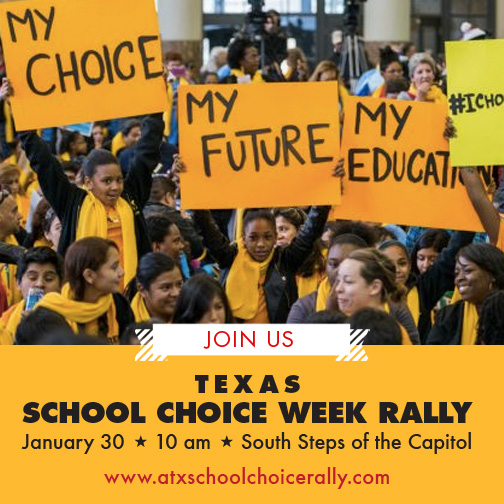
School Choice Week Rally

tx-school-choice-week-rally-013015Order FREE  tickets for the Texas School Choice Week Rally in Austin via Eventbrite:
http://www.eventbrite.com/e/school-choice-for-all-rally-at-the-capitol-tickets-7258080113?aff=efbevent

Join a broad coalition of supporters – including parents, teachers, students and elected officials – to celebrate:

School Choice Week Rally in Austin

Friday, January 30 at 10:00 AM.

This event is open to the public and free to attend.

We will have kid-friendly entertainment, guest speakers, and lots of energy and enthusiasm for school choice!

Why Should Texans Support the School Choice Week Rally?

Because:

……Texas parents are responsible for the education of their children. They are NOT wards of the State!

……Competition makes EVERYONE better, private or public!

……No American should be forced to attend government schools that don’t share their values!

……Too many American children are not reading at grade level, but have been taught that global warming is significantly man-made!

……Too many children are not learning the math / history / geography /civics they need to succeed in life!

……Too many children are taught they are perfect just as they are and do not need to work hard to learn or be better people!

……Schools have become an entitlement for teachers rather than an institution of learning for our students!


AFP Texas National School Choice Week Reception!

AFP Texas logo for National School Choice Week Reception

National School Choice Week Reception


Join AFP Texas for an evening reception celebrating

National School Choice Week in a stunning location!

We’ll have an open bar, appetizers, and special guest speakers discussing school choice and educational freedom.  

Find us on the 15ht floor terrace of the 816 Congress building!

Tickets are free but RSVP is required: NSCWTX@gmail.com

Click on image below for the School Choice Week Reception Webpage:

AFP Texas National School Choice Week Reception


From the AFP Texas website:

“We at AFP want to thank our friends at the American Federation for Children and Alliance for School Choice for the public service announcement, ‘.”

“The PSA features Hall of Fame football player Deion Sanders and retired-WNBA star and Olympic gold medal winner Lisa Leslie. The  in conjunction with National School Choice Week and Super Bowl XLVIII celebrations. The PSA features Deion Sanders, Lisa Leslie, Kathie Lee Gifford, Jalen Rose, Lou Gossett, Jr., Vivica Fox, Stephen A. Smith, Keshia Knight Pulliam, “Mary Mary,” Janet Evans, Theotis Beasley, Mary Millben, Laila Ali and Garcelle Beauvais.”

“The message is a simple one: all children deserve a quality education, and their parents’ zip code should not hinder their ability to go to a great school and get a quality education.  School choice empowers parents to choose the school which will best suit their child’s needs. As we enter the 84th Texas Legislative Session, we will be supporting school choice – and we encourage you to do so too.  Ask your legislator if they support school choice – ask candidates if they support allowing parents to choose their child’s school – public or private – and allow the education dollars to follow the child to that school.”

“It is time for school choice in Texas!”

“Watch this video: PSA: Educational Choice Now!”


Sowell & Williams: 2 Issues that Unite the Races

image

Reaching out to Blacks does not mean offering them the same programs that have destroyed their families and blighted their hope for achieving the American Dream. Studies show that the Way of the American Dream is paved by Faith, Stable two-parent families, Education, and Hard Work.  These three things seem to make avoidance of having children out of wedlock before graduating high school, gang-related activity, crime, and violence more likely.

In Thomas Sowell’s JWR column of March 25, 2014, Republicans and Blacks , Mr. Sowell cites School Choice and Minimum Wage Results as two topics Republicans should publicize and shout out about in order to reach out to Blacks. In the article, Sowell further cites the book, Race and Economics by Walt Williams, as a definitive study of government programs which have hurt Blacks.

Walt Williams on School Choice:

Though many black politicians mouth that we should fix, not abandon, public schools, they themselves have abandoned public schools. They see their children as too precious to be sacrificed in the name of public education. While living in Chicago, Barack Obama sent his daughters to the prestigious University of Chicago Laboratory Schools. When he moved to Washington, President Obama enrolled his daughters in the prestigious Sidwell Friends School. According to a report by The Heritage Foundation, “exactly 52 percent of Congressional Black Caucus members and 38 percent of Congressional Hispanic Caucus members sent at least one child to private school.” Overall, only 6 percent of black students attend private school.” …

“According to a 2004 Thomas B. Fordham Institute study, more than 1 in 5 public school teachers sent their children to private schools. In some cities, the figure is much higher. In Philadelphia, 44 percent of the teachers put their children in private schools; in Cincinnati, it’s 41 percent, and Chicago (39 percent) and Rochester, N.Y. (38 percent), also have high figures. In the San Francisco-Oakland area, 34 percent of public school teachers enroll their children in private schools, and in New York City, it’s 33 percent.”

“Only 11 percent of all parents enroll their children in private schools. The fact that so many public school teachers enroll their own children in private schools ought to raise questions. After all, what would you think, after having accepted a dinner invitation, if you discovered that the owner, chef, waiters and busboys at the restaurant to which you were being taken don’t eat there? That would suggest they have some inside information from which you might benefit.”
Williams’ JWR column, Racial Trade-offs, of Oct. 9, 2013

Thomas Sowell on Minimum Wage:

“Minimum-wage laws are classic examples. The last year in which the black unemployment rate was lower than the white unemployment rate was 1930. That was also the last year in which there was no federal minimum-wage law.”

“The Davis-Bacon Act of 1931 was in part a result of a series of incidents in which non-union black construction workers enabled various contractors from the South to underbid northern contractors who used white, unionized construction labor.

“The Davis-Bacon Act required that “prevailing wages” be paid on government construction projects — “prevailing wages” almost always meant in practice union wages. Since blacks were kept out of construction unions then and for decades thereafter, many black construction workers lost their jobs.”

“Minimum wages were required more broadly under the National Industrial Recovery Act of 1933 and under the Fair Labor Standards Act of 1938, with negative consequences for black employment across a much wider range of industries.

“In recent times, we have gotten so used to young blacks having sky-high unemployment rates that it will be a shock to many readers of Walter Williams’s Race and Economics to discover that the unemployment rate of young blacks was once only a fraction of what it has been in recent decades. And, in earlier times, it was not very different from the unemployment rate of young whites.”

From Thomas Sowell’s article of April. 27, 2011 in National Review,  Race and Economics